beginner tutorial, learning environment, Music Lessons, music performance, music production, piano lessons, piano performance, piano practice, piano teacher, Uncategorized

Short but Sweet: Short Music Courses

Short music courses offer a variety of benefits, making them a great choice for people looking to begin learning musical skills or explore new areas of interest.

Here are some reasons why short music courses are a great option:

🧁 Time-Saving

Short music courses are designed to fit into busy schedules. They allow students to learn new skills without committing to long-term programs or giving up too much time. This flexibility makes them ideal for people with jobs, families, or other responsibilities who want to improve their musical abilities without long term commitment.

🧁 Affordable

Short music courses are typically more affordable than full-length courses. This lower price point makes music education more accessible for people who might not have the financial resources to commit to a full-time program.

🧁 Immediate Results

Because short courses are more condensed, students often see quicker results. Whether you’re learning a new instrument or refining a particular technique, the focused nature of the course helps accelerate progress. This can be highly motivating, as learners can immediately apply what they’ve learned in a short period of time.

🧁 Variety of Topics

Short music courses often cover a wide range of topics. From songwriting to production techniques, students can explore different aspects of music in a short amount of time. This allows for the opportunity to discover new interests or skills.

🧁 No Long-Term Commitment

For those who are unsure whether they want to pursue music, short music courses offer a low-risk way to explore their interests. If they find that a particular course or subject isn’t a good fit, they can move on without feeling like they’ve invested too much time or money.

🧁 Hands-On Learning

Short courses often include practical, hands-on learning experiences, allowing students to apply what they’ve learned immediately. This practical approach helps build confidence and ensures that learners can apply their new skills quickly, such as writing a song, producing a track, or performing live.

🧁 Opportunity for Networking

Many short courses are held in group settings, whether online or in person. This allows students to meet other like-minded individuals, who share their musical interests.

🧁Convenient Online Options

Many short music courses are available online, making it even easier for students to access education . Whether you’re learning from home, on the go, or from anywhere with an internet connection, online courses offer unparalleled convenience.


Are you interested in learning a musical skill? My short music courses are designed to improve your musical abilities in an engaging, simple way:

short music course

Lunctime Liz teaches piano

With the short course: Lunchtime Liz teaches piano, learn basic beginner piano skills in your lunchbreak!

short music course

Electronic music for adults

This course is for adults who have an interest in music production and making electronic music, but are not sure how to begin.

short music course

Electronic music for children and young people

Perfect for children and young people who like computers, and might be ready to explore music as well!

Short music courses are perfect for anyone looking for a quick and focussed way to improve their musical skills, whether as a beginner or an experienced musician looking to expand their knowledge. They’re affordable, and provide immediate benefits, making them an excellent choice!

beginner tutorial, Business, Entrepreneur, learning environment, Music Lessons, music performance, piano performance, piano teacher, Singing teacher, Uncategorized

How to be a musician and an entrepreneur

How to be a musician and an entrepreneur is an interesting position to be in, and also a difficult one.

Of course, everyone knows that being a professional musician in any form is notoriously difficult. After all, if it was easy to make money from something you enjoy, then everyone would do it. Being a professional musician- and I use this term for someone who makes money from music in some form or another-  requires planning, effort, and dedication.

In this blog I will talk a little about some key points if you are considering starting a music teaching business, as this is what I do. Although sometimes I am lucky enough to get paid to perform, realistically this is unlikely to sustain you. Using the skills and experiences I had already, it seemed a next step in life could be to try to teach music. For me, I think it was the right step to take. 

Keep in mind these tips are from the experience I have had. Yours will be different. Part of how to be a musician and entrepreneur is working with who you are, and what you are capable of. If you are not honest with yourself, it will only increase frustration and negativity.

However, the positive bit!

By preparing, providing excellent service, and marketing effectively, you can create a sustainable and fulfilling music teaching business, where you are doing something worthwhile for yourself, and giving something worthwhile to others.

I am always learning and developing my business. I do not have all the answers, but before you entertain the idea further and try to find customers, consider these things:

  • Do you have: a)the practical skills to do this? (teaching experience/qualifications etc) and  b) the personality to do this? (being very self driven, passionate about what you do and organised).
  • There are other avenues you can try without having to go it alone. You could work for a music school or substitute lessons. You could teach as a hobby with much lower stakes, the list goes on.
  • Do you have the time,space and resources to get this off the ground? These are luxuries not everyone has and are necessary to try and start a business. Unless you have a lot of contacts (unfortunately this was not me) you will need to be prepared to put a lot of effort in for maybe six months or more, with very little pay back. Do not give up your day job expecting to be able to earn and live the same way, just with more time to do what you want. You won’t. If it’s not the right time now, that doesn’t mean that the stars won’t align in the future. Patience really is a virtue when it comes to starting a musical business.
  • Clarify what instruments or lessons you will offer (piano, guitar, voice, workshops, groups lessons etc.)
  • Decide on the type of business structure (sole proprietorship, a small company etc.) I am not naturally a business minded person. When I started, I had no clue that there were different options and why. Research research research. Study, learn, ask questions! Check with your local government to see if you need a business license or permits to operate a music lesson business. Here in Sweden I recommend you go to https://verksamt.se/en
  • Online presence- social media- keep branding and be consistent- this is something I need to work more on for sure! Its 2024, you need to develop a website where potential students can learn more about your offerings, pricing, and booking.

A successful musician doesn’t just focus on artistic talent; they also recognize the importance of treating music as a business.

Why is musician entrepreneur different from another type of entrepreneur? It is because you are selling a skill, an experience and a feeling. You’re not giving a product to touch like shoes or a sandwich. How will you make your service feel like a product? This is what most people will want to feel they have. How will you sell the experience?

Once you have your first customer- congratulations! Here are some things to consider when you begin to interact with real paying customers:

  • Providing excellent customer service will help build long-term relationships with students and their families.
  • Communication: Be responsive to inquiries and maintain clear communication about scheduling, payment, and progress. Be punctual. 
  • Stay Passionate: Your enthusiasm for music will be contagious. Let your love for teaching and music shine through in every lesson.
  • Mental Resilience: You may face disappointments and curve balls in your musical and entrepreneurial journey. It is not a 9-5 job. Personally I like routine and structure, and so this is a challenge for me. Many musicians face mental health challenges like performance anxiety, imposter syndrome, and isolation. Developing emotional resilience is an important part of maintaining a healthy musician mindset. It’s an important thing to consider when deciding if a business in music is for you.

Whether you’re just starting out or you’ve been in the industry for years, cultivating a positive and proactive mindset will help you not only become a better musician but also navigate the complexities of a music career with confidence and purpose.

I have learnt a lot of these things the hard way, and I hope my experiences can help others who would be interested in building a business in music but have no clue where to begin.

Remember: The reason people push through the hurdles is because to entrepreneurially pursue something you enjoy even if the payback is small, is incredibly rewarding. 

In my Lunchtime Liz teaches piano course, I will cover a little more about musician mindset. Even if you have no intention of being a musician or an entrepreneur, it is worth keeping in mind. Sometimes you have to talk to yourself in a certain way to get the most enjoyment from learning music!

I think this is something which is not often covered in music lessons, but can really help people maximise their potential and minimise their disappointments in the journey to learning a musical instrument. I will also be providing an e-booklet as a resource to the people on the course, elaborating and adding to the entrepreneurial aspects and the musician mindset covered in this blog.

Who knows, I might even make another blog about how to be a musician and an entrepreneur…watch this space!


learning environment, Music Lessons, piano lessons, piano practice, piano teacher, singing lessons, Singing teacher, Uncategorized

Why individual music lessons are beneficial for students.

Its been a little longer than usual since I posted a blog, it is a busy time of year for music teachers! Students beginning lessons after summer break, or some students learning an instrument for the first time- exciting stuff!

For this blog, I’ve mainly focussed on why individual piano lessons are beneficial, but individually tailored music lessons are beneficial for students regardless of instrument, or subject. Some of the reasons I’ve listed here, easily cross over to whatever you want to learn.

Learning the piano is a journey that varies greatly from one student to another. Whether you’re a beginner or someone looking to refine advanced skills, here are some reasons why individual tailored music lessons are beneficial for students.

Personalized Learning Pace: Every student has a unique learning speed. Individual lessons adapt to this pace, ensuring that students grasp each concept thoroughly before moving on. This prevents frustration and builds confidence as students see their progress clearly.

Focused Skill Development: A one-size-fits-all approach often fails to address specific strengths and weaknesses. Tailored lessons allow the teacher to focus on areas that need improvement, whether it’s technical skills, sight-reading, or expression. This targeted approach accelerates learning and makes practice more efficient.

Incorporating Personal Interests: This one I believe is very important. Ultimately, your students need to enjoy what you are teaching them, (sometimes they will enjoy it more than other times!) However, if their lessons are constantly not making them feel good, either:

a) this will become evident and the lessons will be more or a struggle for both you and the student, or

b) they will eventually stop learning.

Although fundamental, learning music is not just about scales and exercises.

Individually tailored lessons can incorporate the student’s musical tastes, whether they’re into classical, jazz, pop, or any other genre. This keeps students motivated and engaged, making the learning process enjoyable. It also challenges you as a teacher to a create fun and engaging lessons. I often have to figure out: “How can I incorporate my students love of ____ so that they learn _____?”

Check out my instagram page @lizteachespiano

Adapting to Learning Styles: Everyone learns differently—some are visual learners, others auditory or kinesthetic. Individual lessons can adapt to these learning styles, using methods that resonate best with the student. This personalized approach ensures that the student not only learns, but retains the information, thus keeping lessons fresh for you and the student, because you can introduce new ideas to the lesson each week.

Setting Realistic Goals: With individual lessons, teachers can set realistic and achievable goals that align with the student’s abilities and ambitions. I always ask my students (no matter the age):

“Why do you play piano?” and “How much time do you have to practice?” . This approach helps in maintaining a steady progress curve, keeping students motivated as they reach each milestone.

In summary, tailored piano lessons provide a fully customisable path to musical proficiency. Each student can receive the guidance and support they need to reach their full potential.

Whether you’re just starting or looking to advance your skills, personalized instruction is key to a rewarding and successful learning experience.

If you’re interested in brushing up on your music skills, or taking the leap and starting to learn, please feel free to book a trial lesson with me today 🙂

beginner tutorial, learning environment, Music Lessons, piano lessons, piano performance, piano practice, piano teacher, singing lessons, Singing teacher, Uncategorized

Get prepared and stay organised! Your music teacher checklist

As a music teacher preparing for the back-to-school season (or maybe you are starting this semester!) you’ll need a variety of resources that can help you organize your lessons, engage your students, and enhance your teaching.

Here are some valuable resources I have discovered across different categories which I have put together into a music teacher checklist available to download in this blog!

Your music teacher checklist, Lesson Planning and Organization

You will need some sort of planner. Now, personally I like to have a notebook AND digital notes- I use a notebook often for when I travel, and for planning child lessons, and I use digital for when I am teaching from home, or teach adults.

I use Microsoft OneNote because I already had it, and I like that I can just write on my laptop like a tablet, then email the notes to my student after the lesson.

For students: If you are a student reading my blog, don’t worry I haven’t forgotten you! A lot of these resources could also work for a student taking the leap with piano lessons or other music lessons too!

Music practice notebook : this little book has a space for teachers, and parents to write notes- and at the bottom gives a tip for practice that week!

I created “Your music teacher checklist”: available to download for free here!

Teaching Materials and Sheet Music

These are the most important things for teaching music. Figure out the payment systems, and scheduling later, because without teaching materials, you will struggle to teach. It is also important to remember: you will build these up gradually. Take it step by step and don’t buy everything at once: Firstly because if you buy a lot of things which turn out to be not useful, you’ve made a loss, and secondly because your teaching path may go down a different route than you first anticipate.

You will probably want:

Music books

  • Music books: just get a few to start with- I like Piano Time books by Pauline Hall, and also the Faber piano adventures look clear and structured.
  • Duet music book: I have found that duets are great for sight reading (both yours and students!) and is a way to help your student build confidence in playing music. Plus, it shows music can be fun (its always quite fun for a student to see if you make a mistake, and its rewarding when you play the finished piece together.)
  • Music Theory resources, which follows nicely to:

Supplementary Materials

Worksheets and Printables:

  • Teach piano today: A very useful resource.
  • Flashcards: You can easily make some. Also Musical snap is very popular with my students. You will need some sort of musical game, because learning a skill is tiriing, and it is nice for you and the student to keep it fresh and fun. Google and you will be amazed the free resources on offer!
  • Making Music Fun: Offers a variety of printable music theory worksheets and activities.

Games and Activities:

  • Teach Piano Today’s WunderKeys: A program with fun, game-based learning for young beginners.

Technology

Use technology. Even if it sounds scary- there really are an abundance of resources online and you can also find out lots of things about how to improve your teaching, and different learning techniques etc etc.

Digital Tools:

  • Online Music: musicnotes.com is useful, but I am sure there are others!
  • Online music notation software that allows you to create and share sheet music. I like Noteflight
  • Stand for a camera or phone so you can record you playing a scale, or a section of music to send to your student.
  • Consider providing students with recordings of their playing, which can be a valuable teaching tool.
  • Spotify: to listen to songs your students like and you can try to transpose!

I hope the ” Music teacher checklist” resource I have created can help you get started for the new semester! You can download below:

learning environment, Music Lessons, piano lessons, piano performance, piano practice, piano teacher, singing lessons, Singing teacher, Uncategorized

Music Activities for Piano Students During the Summer.

Plus a free resource!

The Importance of Music Activities for Piano Students During the Summer.

Summer break offers a great opportunity for piano students to deepen their musical skills, explore new avenues of their talent, and maintain their progress. While the school year is often packed with structured lessons and practice schedules, the summer months can be a time for creativity, exploration, and enrichment through various music activities.

Here are several reasons why engaging in music activities during the summer is crucial for piano students:

Preventing Skill Regression

One of the primary reasons for maintaining music activities over the summer is to prevent the loss of skills. Extended breaks without practice can lead to a decline in technical proficiency and musicality, which can then lead to a lack of interest. Regular engagement in music activities helps ensure that students retain their abilities and hopefully want to continue music lessons with you next semester!

Creative Freedom and Improvisation

During the summer, the pressure of recitals and exams is often lifted, allowing students more musical freedom. This is an ideal time for them to experiment with improvisation and composition. These activities can enhance their understanding of music theory, boost their creativity, and increase their confidence in playing.

Fostering a Lifelong Love of Music

Engaging in music activities during the summer can help foster a lifelong love of music. When students associate music with fun and exploration, they are more likely to continue playing and enjoying music throughout their lives. Summer activities that blend learning with enjoyment can help create a lasting passion for piano and music in general.

What musical activities can students do in the summer?

Attend a concert!

Concerts provide music students an opportunity to witness professional musicians at work. Observing high-level performances can be very inspiring for students to elevate their own playing standards. If I have a live show, I will often invite my students to come and watch, as live music has a unique way of inspiring and motivating students. If you’re local, be sure to check my events page 🙂

Learning Music Technology

The summer break is an excellent time for students to delve into music technology. Learning to use music software, recording techniques, and even basic sound engineering can be both fun and educational. These skills are increasingly important in the modern music landscape and can add a new dimension to a student’s musical toolkit. Even something as simple as your student video calling a relative and performing for them can count!

How can you as a music educator help your students with summer practice?

Prepare

Keep in mind when your students last lesson is before summer and make sure you give them some music to work on which you have worked on in lesson- something new and complicated will not keep that music passion going, only cause frustration!

Save time to thank your students and parents at the end of the lesson for their time.

Learning a skill requires dedication and commitment- as well as giving your students instructions as to what to work on during the summer, be sure to acknowledge that.

Give them a summer activity!

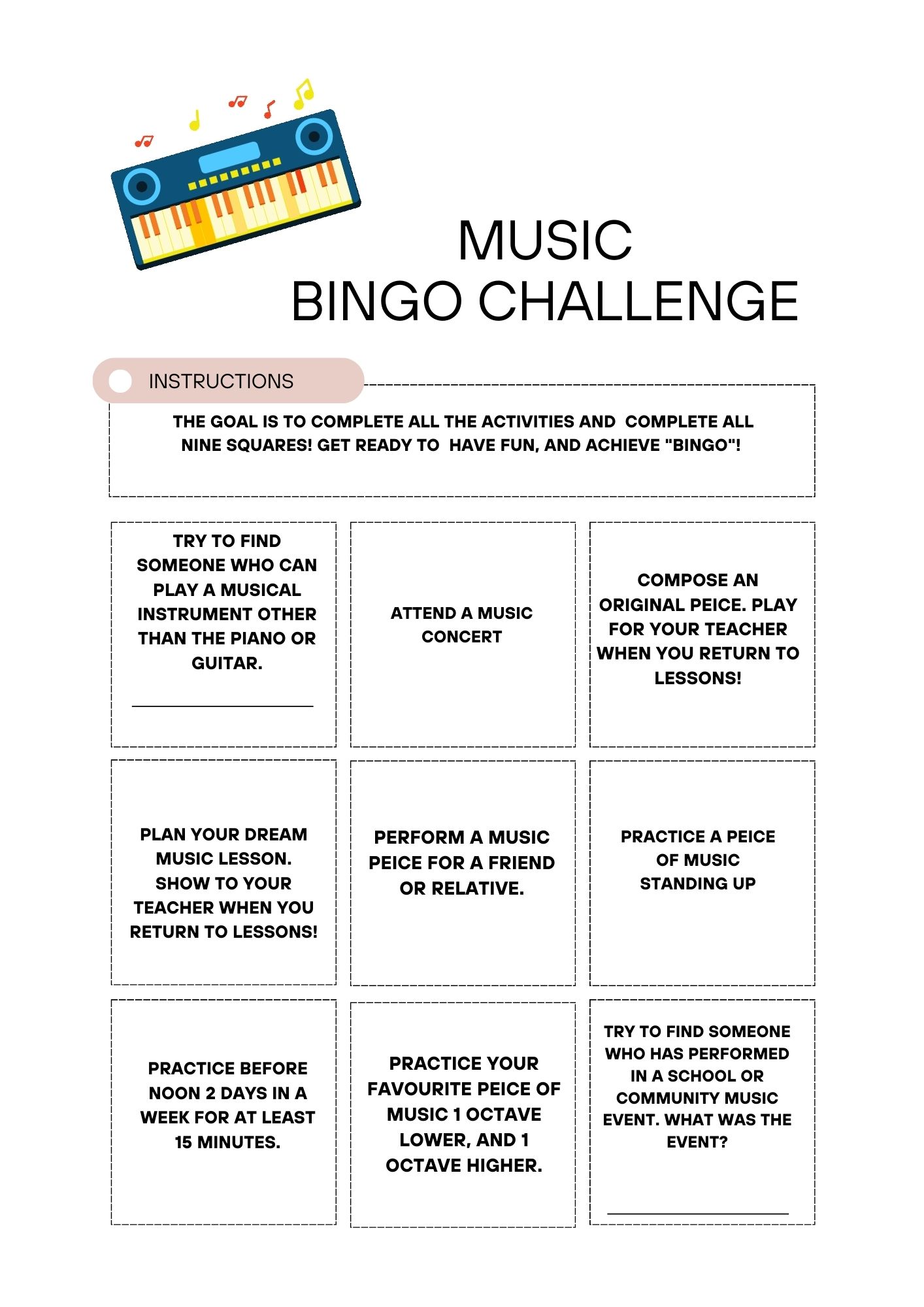
Give your students a simple summer activity related to music which they can work on throughout the summer. Keep in mind that some students will be travelling and not have access to a piano. This is why I have created a Music Bingo worksheet! There are others around, but I have come up with some of my favourite ideas, a mixture of practice and enrichment to keep students engaged in the summer months. Of course they do not have to complete every activity, but its great if they do!

Thanks for reading! 🌞😎